Nest Guardians: The Monumental Work of Sea Turtle Monitors on the Beaches of Miches
MICHES. Patricio’s face lights up as he recalls the day he played with a baby leatherback turtle on Esmeralda Beach in Miches. He was overjoyed to see it hatch, after many sleepless nights guarding the nest its mother had prepared in the sand to prevent it from being stolen.
Enchanted by its tenderness and very satisfied with his work, Patricio solicitously stroked the baby, when suddenly a hungry and swift bird snatched it from his hands and took flight with the newborn in its beak.
“I wanted to run after that bird,” says Patricio Mercado, whose story describes his high sense of responsibility as a member of a team of eight coastal monitors, whose mission is to protect sea turtles on the coasts of the municipality of Miches.
These young people are the main asset of the Miches Sea Turtle Monitoring and Protection Program (Prototortoise), which aims to ensure the conditions for the reproduction of sea turtles on the beaches of Miches and Lavacama, based on a public-private-community alliance that prioritizes resilient and regenerative tourism development.
In addition to Patricio Mercado, the team is completed by César David Peguero Leonard, Guillermo Sosa Amparo, Franklin Yunior Cabrera, Manuel de Jesús Cabrera, Juan Angel de la Rosa Castro, Santo Cordones Zorrilla, Anyelo Tejeda de la Cruz and Marcos Severino Rodriguez.
Prototortoise It has a total reach of approximately 50 linear kilometers of beach, of which 43 kilometers are monitored continuously during the season. Specifically, the program covers the beaches: Esmeralda Este, Esmeralda Oeste, Celedonio, Limón, Barbacoa-Nisibón and Lavacama.
The coastal monitors are the children of fishermen and park rangers, and because of their empirical knowledge of the beaches and the species that coexist on the coasts, they were hired by Protortoise for the season from February to September.
DAY BY DAY… NIGHT AFTER NIGHT
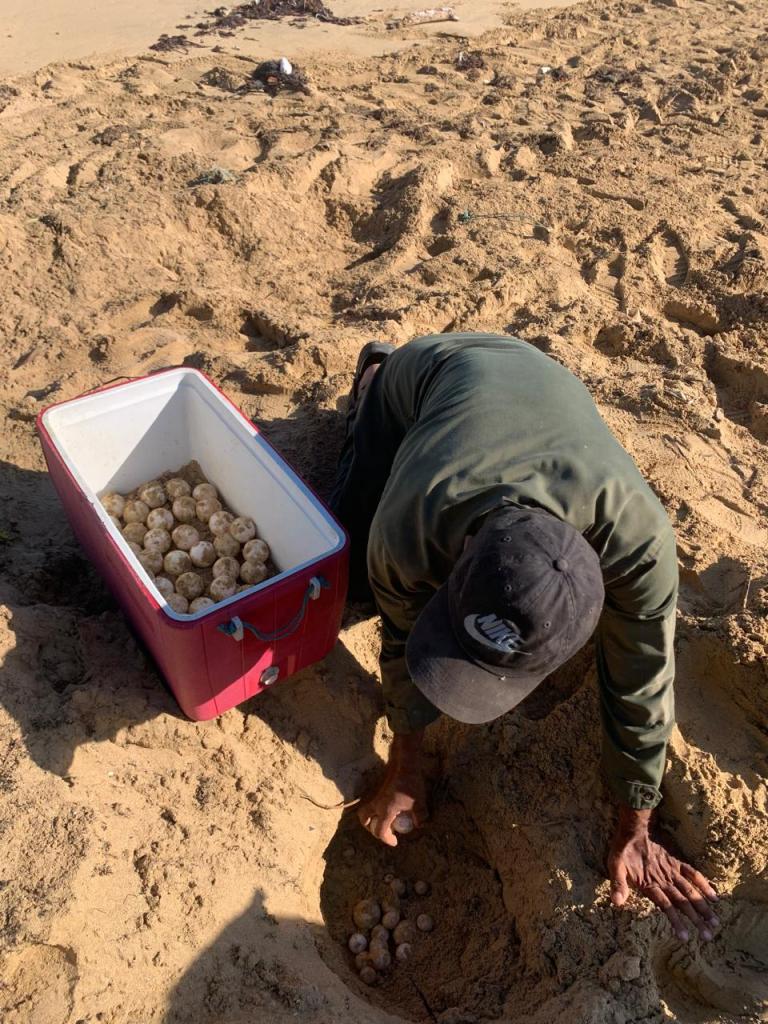
The job of coastal monitors is to patrol the beaches for mother turtles and their nests. Once located, they meticulously collect the required information on forms designed for that purpose, and jealously guard the nests until the hatchlings emerge.
This data includes taking measurements of the mother turtle, such as the width, length, and diameter of her neck. Subsequently, they perform an accurate count of the hatchlings that emerged and those that did not, recording all relevant data.
With that information, “we determine whether the eggs laid by the mother stay there (in the beach sand), or whether we take them to the hatchery. When a mother lays eggs in a place where there are no guarantees that those eggs will survive, we take them to a hatchery and incubate them,” explains Yonattan Mercado, Patricio’s brother and coordinator of the Conservation and Research area of Prototortoise.
Currently, there are seven nests in a hatchery because monitors detected irregularities that could affect the normal incubation process. Incubation extends the hatching time, which naturally on the beach can take two months, while in a hatchery that time is prolonged to up to three months.
It’s an intense job that requires dedication and conviction. “It feels like an adrenaline rush when you see the turtles’ tracks and you want to find the eggs to protect them. That’s how you experience it. The thrill is finding the eggs and protecting them,” says Marcos Severino, a member of the coastal monitoring team.
They work day and night shifts. Surveillance isn’t always fun. The monitors say they’re often attacked by mosquitoes and other insects in the dark, or caught in a downpour, something very common on the coast.
“It’s something you really have to love, because it’s difficult. We even give up sleeping comfortably at home, to wake up in a hammock,” says Patricio, proud of what he does.
There is a team that walks the beaches in the mornings and assesses whether the eggs are in danger or at risk of getting wet from seawater. “The leatherback turtle mothers come at night. For that reason, we are also on the beaches, doing night patrols, until we find the mothers,” explains Yonattan Mercado.
He explains that since the estimated time for a turtle to emerge and lay its eggs ranges from one hour and 40 minutes to two and a half hours, the monitors’ job during this phase is to prevent a human predator from discovering the nest and stealing the eggs. This is one of the main reasons why, during nesting season, the monitors spend the night on the beaches.
With a touch of nostalgia stemming from the overprotective bond they share with these creatures, the monitors speak of the final moment of their work. They know well that their task begins with finding the nest and caring for the eggs, from incubation to the exciting hatching. But the natural cycle must continue. “Our job is to look after them while they’re on the sand,” says Yonattan. Now strong enough to move forward, the hatchlings walk slowly and hesitantly to the sea, where a new life awaits them.
FROM SALE TO PROTECTION
In one season, between four and six mother turtles, usually leatherback turtles, can nest on the Miches coast. Each one lays eggs three or even four times.
This means that more than 20 nests can be discovered in a single season, as projected. Protortoise for this nesting season. A mother can lay up to 150 eggs per nest, and of those, fertile eggs number between 70 and 80.
Before the monitors’ work, these eggs were sold on the streets of Miches like any other product. No one challenged this illegal practice, which threatens the preservation of the endangered leatherback sea turtle.
“But we have almost completely won the war. Nobody is chasing the eggs anymore. There was a predator, which was man. And we have won the war. People are now aware, because nobody protects what they don’t know,” Patricio acknowledges.
The monitors say that the people of Miches contact them immediately when they discover a turtle nest. They acknowledge that the town has shifted from a culture of stealing to one of protecting the eggs of these marine species. But they are aware that vigilance must be constant.
The efforts of these guardians have fallen on fertile ground. According to data provided by PrototortoiseAs of May 31st of this year, 21 nests have been identified and protected, distributed as follows:: 13 in Playa Esmeralda Este; five in Playa Celedonio and three in Playa Lavacama.
The same data indicates that no stolen nests or hunted turtles have been reported this season. In 2023, 1,399 normal eggs were recorded, and 728 hatchlings of three species of sea turtles were counted.
A VERY SPECIAL SPECIES
The leatherback sea turtle (Dermochelys coriacea), the most common turtle on the beaches of Miches, is listed as vulnerable and since 2013 has been evaluated for inclusion in the Red List of Threatened Species of the International Union for Conservation of Nature (IUCN).https://www.iucnredlist.org/es/speciesThis classification is based on criteria that indicate that the species faces a high risk of extinction in the wild.
Also known as the leatherback sea turtle, the leatherback is the largest sea turtle in the world. It can reach lengths of over two meters and weigh up to 900 kilograms. It inhabits all oceans, from the tropics to the cold subpolar waters, although it prefers warm waters for nesting.
In September of last year, the Ministry of Environment and the El Seibo-Miches Hotel and Tourism Association (Promiches) formalized a collaborative commitment to implement a monitoring and protection program for sea turtles in tourist areas of the eastern region.
“Leatherback and hawksbill turtles play an important role in the marine ecosystem, and they also fulfill important ecological functions. For this reason, we contribute to the preservation and care of these species,” explains Carlos de la Rosa, provincial director of the Environment in El Seibo.
The entities that signed the aforementioned agreement committed to promoting education, social awareness, research and scientific dissemination about the species that nest in the Miches area, in El Seibo, for more than five years.
David Montesdeoca and Victor Souffront, representatives of the Eastern Environmental Coalition, also emphasize the role of turtles as a vital component of marine ecosystems and in the balance of the oceans. They point out that beach sand would remain infertile without the cyclical contribution of nutrients provided by sea turtles.
“The arrival of these species on beaches to lay their eggs promotes the transfer of minerals from the ocean to the surface and vice versa, maintaining a healthy exchange for both ecosystems. By digging their nests, they move tons of sand, refreshing the beach’s nutrients. Unfortunately, many species of sea turtles face threats to their survival, such as habitat loss, climate change, and poaching,” Montesdeoca and Souffront stated in a joint declaration at the request of this publication.
WHY THE BEACHES OF MICHES
The leatherback turtle prefers the beaches of Miches because this coastline has very unique characteristics related to its nesting needs and the local environment, such as:
Wide, sandy beachesLeatherback sea turtles need beaches with enough space and suitable sand to dig their nests and lay their eggs. The beaches of Miches meet these requirements.
Low human interferenceLess developed beaches with less human activity are preferred by these sea turtles to avoid disturbances during the nesting process.
Ideal temperatureThe temperature of the sand is crucial for egg incubation. The beaches of Miches have a climate and sand temperature that favor the successful incubation of leatherback sea turtle eggs.
Easy access to the seaAfter hatching, baby turtles need direct and rapid access to the ocean. The beaches of Miches offer unobstructed access from the nests to the water.
CHALLENGES
Sea turtles are protected by national legislation. Decree 285-23 prohibits the capture, killing, egg collection, and commercialization of sea turtles of the following species: Green turtle (Chelonia mydas), Hawksbill turtle (Eretmochelys imbricata), and Leatherback turtle (Dermochelys coriacea).
And the General Law of Environment and Natural Resources (64-00), in its article 136, paragraph 1, declares of high national interest “the conservation of native and endemic flora and fauna species, the promotion of their reproduction and multiplication, as well as the preservation of natural ecosystems that serve as habitats to those species whose survival depends on them, which will be subject to rigorous in situ protection mechanisms.”
The scope and applicability of these regulations, however, face the challenge of supporting the spillover of an investment exceeding one billion dollars in the construction of 4,551 hotel and residential rooms in Miches, according to data from the Ministry of Tourism.
This represents a substantial increase in the number of tourists walking along these beaches, which have traditionally been preferred nesting and breeding grounds for sea turtles. De la Rosa, as the provincial director of the Environment Ministry, is aware of this significant challenge in the preservation of sea turtles.
“Therefore, we have drawn up, with technical staff from the Ministry, in coordination with Prototortoise“The constant monitoring by the assigned personnel is essential to prevent potential losses and ensure that the specimens are not stunted, as they are also considered an attraction for ecotourism in the area,” explains De la Rosa.
The general coordinator of PrototortoiseGustavo Román is well aware of the importance of official regulations for the care of these species. That’s why he emphasizes community involvement. “They are our allies, on the same level as the public sector and our colleagues in the private sector. The conservation of sea turtles in Miches is the responsibility of all stakeholders in the municipality, and the success of this initiative lies in working together.” Prototortoise“Román points out.”
Last year, the program brought together 353 participants in the workshop “Importance of Sea Turtles in the Marine Ecosystem” and 31 hotel collaborators participating in the workshop “Identification and Management of Sea Turtle Nests”.
To continue growing, Protortoise This year, the organization is working on several fronts. Among them is the construction of hatcheries, with the approval of the Ministry of the Environment, at Playa Esmeralda and Playa Limón. These hatcheries will be used to relocate nests from areas at socio-environmental risk and keep them in safe conditions. The goal of this initiative is to ensure, under proper supervision, the maximum number of hatchlings and successful migrations to the sea.
WHAT’S NEXT
The sea turtle conservation program in Miches has planned a series of strategic steps to strengthen the protection of these species. It has decided to expand the scope of its monitoring to a greater number of beaches, including Lavacama, a key area for sea turtle nesting. Furthermore, the monitoring period will be extended until September, encompassing the nesting season for species such as the Hawksbill and Green Turtles.
To improve data management, significant enhancements will be made to the program management system. This will ensure efficient information gathering and effective analysis of the data collected during monitoring activities.
To ensure the success of these measures, the participation and commitment of local governments will be actively sought. This will include working together to establish regulations and standards that promote optimal conditions for the reproduction and protection of sea turtles within coastal municipalities.
HISTORY IN GRAPHICS
Learn more about sea turtle conservation in this detailed infographic: SEE HERE