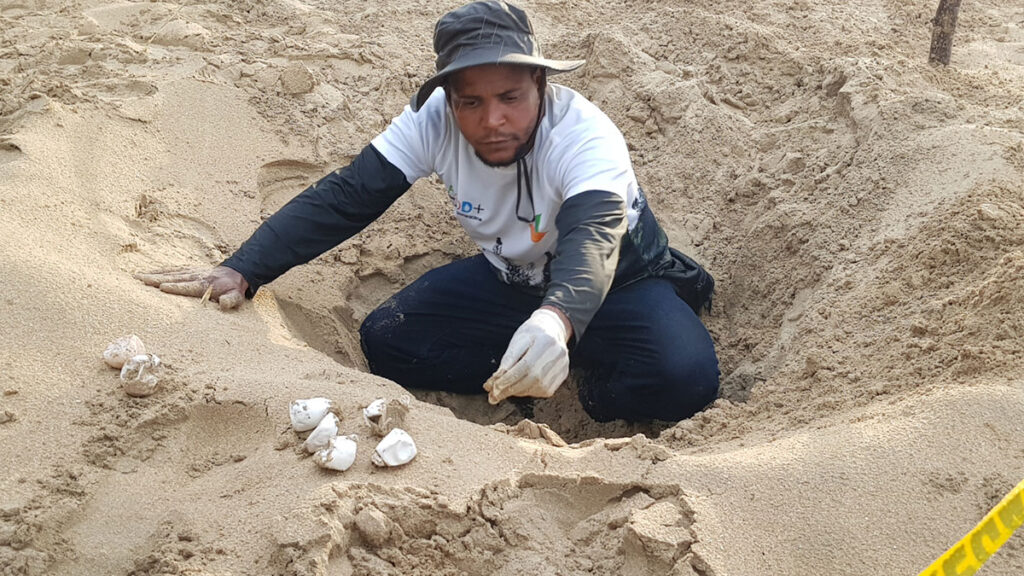
The first leatherback turtle nest of the 2021 season hatches in Miches.
Private sector leadership, public sector technical coordination, and active community involvement have been the differentiating factor for this year's success.
Last March marked the beginning of the nesting season for the leatherback turtle, Dermochelys coriacea, in the country, and with it the start of the Marine Turtle Monitoring and Protection Initiative in Miches, a pilot program implemented in Playa Esmeralda under the coordination of the Ministry of Environment and Natural Resources MIMARENA, and the El Seibo-Miches Hotels and Tourism Association Promiches.
“To date, we have identified and marked five leatherback turtle nests as part of this initiative. The ongoing support of the El Seibo-Miches Hotel and Tourism Association (Promiches) has been the key differentiator this year, and as a result of this joint effort, we have not had any turtle deaths or nest thefts at Playa Esmeralda,” commented Cristiana de la Rosa, Head of the Coastal and Marine Ecosystem Restoration Program at the Ministry of the Environment.
Last Sunday, May 16, the first hatching of the season in the country was marked by the birth of 92 leatherback sea turtle hatchlings. “It’s a very exciting event, one that people quickly connect with. Being part of the team that helped safeguard an endangered species like sea turtles is part of our tourism development strategy and something that fills us with great satisfaction,” said Gustavo A. Román, Executive Director of Promiches.
To make this possible, the Ministry of Environment staff assigned to Miches patrol the beaches continuously, waiting for the turtles to protect them during nesting, when they are most vulnerable to being hunted for their meat and the theft of their eggs. They then identify the nest, fence it off, and mark it, and from then on guard the eggs for sixty to sixty-five days, until they hatch.
“At the Vice Ministry of Coastal and Marine Affairs, and particularly under Vice Minister José Ramón Reyes, we are closely monitoring the country’s coastlines, including Playa Esmeralda, to protect turtles from both natural and man-made threats. This year, through the “Resilient Seibo” project, we have installed signage along the beach to inform visitors of the turtles’ presence. The involvement of the hotel and tourism sector in Miches has provided us with more tools and resources to carry out this work. We must also acknowledge the role of the community in this project; their awareness of the importance of the species helps us monitor turtle nesting sites and identify threats.”
“It is only fair to mention the support of companies like Tropicalia and Bahía Esmeralda, whose employees, along with community residents like Mr. Edwin Rodriguez, have been part of this team since day one,” explains Cristiana de la Rosa.